
The Ibex
28th May 2026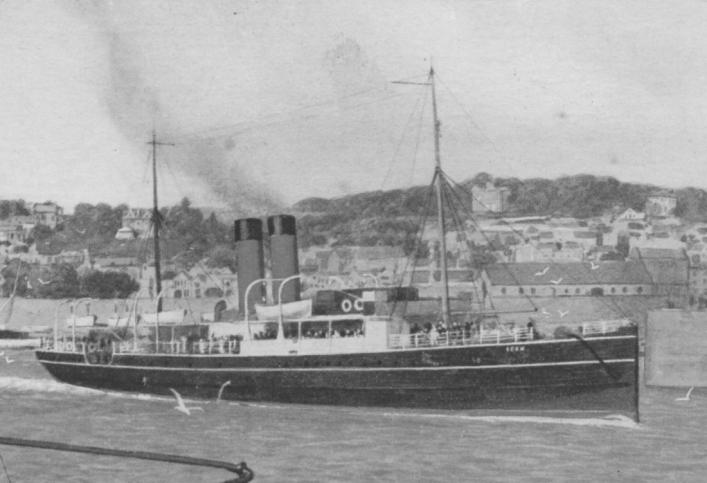
Some travelling nostalgia from The Marine Engineer, London: 1893. Edn. of May 1, 1892. 'Improved passenger steamship service to and from the Channel Islands. Weymouth Route.' The modern and comfortable delights of the new Ibex steamer, with its gold Japanese wallpaper, which was contemporary with and encouraged by the launch of the Weymouth boat train in 1889. The train was an icon for Channel Island travellers for nearly a century, until its much lamented withdrawal in September 1987. It lasted considerably longer than the Ibex, which was retired and broken up in 1925. The image of the Ibex leaving St Peter Port harbour is from a postcard in the Priaulx Library collection.
SINCE we published an account of the excellent new service of steamers of the Great Western Railway Co. plying between Weymouth and the Channel Islands, in the series of articles which appeared in the MARINE ENGINEER in 1889, on Passenger Steamships of British Railway Companies, so successful has this service proved, that Messrs. Laird, the builders of the Lynx, Antelope, and Gazelle, then running thereon, have built for the company, and for the same service the Ibex, which is a more powerful steamer, and in several respects more luxurious. As it has been rumoured that the company may in the near future order two new steamers of the same type, but with a few further improvements both as regards speed and accommodation, to be run on a daily service which they may start from Weymouth to Guernsey and Jersey, a detailed description of the Ibex is likely to be interesting to our readers.
This ship is a steel twin-screw steamer, and has a straight stem and elliptical stern. She is schooner rigged, and has two masts and two funnels. Her length is 270 ft.; breadth, 32.6 ft.; and depth, 15.6 ft. She has a gross tonnage of 1,160, and a net tonnage of 372. She is a spar-decked steamer, and has an excellent promenade deck for first-saloon passengers, extending to three-quarters of the length of the ship. The Ibex has also a spacious poop, which is highly appreciated as a promenade for second-class passengers. The subdivision arrangement is all that can be desired. The hull is divided into 13 watertight compartments by nine transverse bulkheads, and iron flats. The steamer is also provided with five lifeboats of the best design, placed high above the deck-house, and which do not therefore interfere with the promenade space. There are superior water tanks above the deck-house, so as to ensure a good fall of water all over the ship.
The machinery consists of two sets of direct-acting triple expansion engines, having inverted cylinders, whose dimensions are 22, 34, and 51 in. by 33 in. stroke. The piston and piston-rods, and crank-shafts are of steel, and the engines, which have been strongly constructed, are supported by cast-iron columns in front and malleable iron columns at the back. In the wing of the steamer circular condensers have been placed, and there are two centrifugal pumps. The ordinary link motion is in use. There are two double-ended boilers, side by side. Their diameter is 14 ft. 4 in., and their length 18 ft. 6 in. There are six furnaces in connection with them, and there are separate combustion chambers to each furnace.
Under forced draught, with closed stokeholes, the pressure is 160 lbs., the air pressure being ¾ inch, which is obtained by four single inlet fans of 6 ft. diameter, working at about 300 revolutions per minute, and placed above the main boilers. The boilers are fed by a separate double-crank steam pump, and auxiliary duplex-feed pump. Joy's assistant cylinder is used for balancing the low-pressure slide-valve, and all the latest improvements have been introduced into the engine and boiler rooms. An auxiliary boiler fixed between the funnels supplies steam to the electric light engines, fan engines, steam-winches, and windlasses. The main copper steam-pipes are lapped with wire. The propellers, which are four-bladed, and of 10 ft. diameter, are of manganese bronze.
The electric light installation is splendid. It was entirely put up by the Great Western Railway Co., under the superintendence of Mr. Spagnoletti, electrician to the company. No less than 196 lights have been provided throughout the Ibex, consisting of 25 8-candle power lamps to illuminate the dome; three 100-candle power lamps in each of the holds; nine 100-candle power lights on deck, and the remainder of 16-candle power over the ship. The return-wire system is in use, and the current is supplied by a direct current dynamo, driven by a powerful auxiliary engine. The revolutions are 450, with a voltage of 80, and 400 amperes of current are supplied. The insulation is of the most efficient kind. There are eight distinct pairs of mains. The switchboard is in the dynamo-room amidship. The fittings are very artistic, and the steamer is seen at its best when illuminated.
The contract speed was from 18 to 19 knots an hour, with an I.H.P of 4,000. The Ibex was taken for three runs. The first was against the tide on the last of the flood, the time taken being 26 minutes 45 seconds, or a speed of 18.61 knots. The second trial was also made against the tide on the first of the ebb, the result being 25 minutes 52 seconds, equivalent to a speed of 19.29 knots, and the third run, made with the tide on the beginning of the ebb, was made in 25 minutes and 38 seconds, or 19.45 knots per hour. Having regard to the Admiralty mean of means, so as to eliminate tidal influence, the speed performed was equal to 19.17, with the wind and sea if anything unfavourable. The I.H.P. developed was maximum 4,350, mean 4,250. The revolutions were 152, and the pressure was about 150 lbs. The air pressure was about of an inch, and the stoke-hold temperature 98 to 100. The bearings were cool throughout, and the engines worked smoothly and well. The absence of vibration, even when going at full speed, and with a roughish sea, was very favourably commented upon by all on board during the trial trips of the steamer. The excellent manœuvring powers of the Ibex, which were severely tested, were also highly praised.
In responding to the toast of the Great Western Railway Co., proposed by Mr. Laird, of Messrs. Laird & Co., builders of the Ibex, on the occasion of the trial trips of this steamer, Captain Lecky, R.N.R., marine superintendent of that railway company, said that "about a year ago the directors decided to build a vessel of the very highest class for their Weymouth and Channel Island service, and under these circumstances there was nothing left for them but to select the most competent builders, and having had previous favourable experience of Laird's, the most natural thing they could do was to come back to Birkenhead; that their action was justified was shown in the results achieved that day. About the same time the Chairman of the South Western Railway Co. was reported to have said, in the course of a public speech, that he was building three boats, which would make the Great Western people sit up. Well, he had made them sit up to the tune of the Ibex, and it was a pretty tune indeed. He wished it, however, to be distinctly understood that this vessel was not the retort courteous to the South Western Co., the sole reason being to meet their own increased traffic, which had latterly gone up, so much that they were incapable of adequately dealing with it. ... The South Western drew their passengers from the London district, while the Great Western people depended upon the West of England and the Midlands. They had no idea of vying with the South Western Co. in point of speed, although they could easily have surpassed it in the Ibex, but the directors preferred not to do so; for a vessel of her size, he believed there was no cross-channel steamer afloat which combined her speed and elegance."
The engines are placed in the after part of the amidship section, and the first-class passenger accommodation is isolated from the engine and boiler-rooms, and is situated forward of all the machinery, consequently no vibration is experienced. There is a capital deckhouse on the spar deck, containing the ladies' deck saloon, the ordinary deck saloon, smoke-room, and captain's room, and on the top there is a splendid elevated bridge and steering-house forward of the funnels, eminently suitable for look-out or navigation.
The first or grand saloon is on the upper deck, and is entered from the spar-deck by a beautiful and highly ornate wide staircase leading from the deck saloon. This very spacious and luxuriously decorated and furnished room presents the most sumptuous aspect when illuminated with the electric light, and in this respect it is equal to and in several particulars superior to the first-class saloon arrangements of the better class of ocean liners. Two wide folding doors with plate-glass windows lead into the saloon, which in width measures the whole 32 ft. 6 in. of the steamer's beam, while the length of the room is about the same dimensions. A splendid square apartment like this gives this saloon a very great advantage as regards accommodation for meals. A walnut table is placed on either side of the saloon for nearly its whole length, close to the entrance there are two elegant sideboards of walnut and satin wood, they are surmounted with beautiful black-veined marble tops, and nico nickel-plated rails. The esthetic appearance of the saloon is further enhanced by an ornate walnut plate-board in the centre, containing a beautiful service of plate, artistically placed upon it, and over which is a very nice glass rack, supported on two small pillars, very tastefully designed. The revolving chairs for use at the tables and the surrounding couches are beautifully cushioned with sage-green plush.
In the middle of the saloon there is a magnificent lantern, which extends the whole width of the deckhouse, and is covered with stained glass. This lantern, in addition to giving much agreeable light to the saloon in the daytime, greatly adds to its artistic appearance. Near the top there is a carved cornice, relieved in white and gold, and it is brilliantly illuminated with the electric light at night. That part of the sides of the saloon immediately over the tops of the couches is covered with excellent Japanese wall-paper, in crimson and gold. The sides are further embellished by artistic mirrors and a number of elegantly-framed pictures of Channel Island scenery, specially painted for the Ibex by Mr. Creswick Boydell¹, and which contains some excellent pieces of Guernsey and Jersey scenery. The ceiling of the saloon is decorated in bead moulding and relieved with gold. Opposite to the entrance to the saloon there is a handsome fireplace, such as would be seen in an elegantly furnished large room in a private house, hotel, or club. It's provided with a good chimney and a beautiful mantelpiece, mirror, hearthstone and fender. On a cold day it is impossible to overestimate the comfort and cheerfulness of this superior arrangement. The saloon is further warmed in cold weather by steam-pipes running under the couches. The ventilation of this magnificent apartment is also highly appreciable. On either side there are large port-holes of about 13 in. in diameter, and when these cannot be comfortably opened in bad weather, agreeable ventilation can be obtained from the small apertures of perforated plates, of about 24 ft. in length, which are fixed over the port-holes. So great, in short, is the luxury and convenience of this grand saloon, that no one could have imagined five years ago that such a splendid room could have been provided in a cross-channel steamer.
At the after-end of the first-saloon on each side there is a large lavatory, with an encaustic tiled floor, w.c.'s, and all the most improved fittings and patent exhaust ventilators. The pantry also, at the after end of this saloon, is very spacious, and has also the best modern appliances, including a speaking-tube, and special lift to the smoke-room.
The ladies' saloon is entered from the promenade deck, and also from two doors in the grand saloon. The former apartment is one of the most beautifully decorated and upholstered rooms to be found on any steamer. Above the dado there are highly ornate panels, containing Japanese paper in canary and gold, and whenever possible the walnut background underneath the paper has been adorned by satinwood and maple panellings. There are several beautiful bevelled mirrors in this room. These artistic decorations, and the light blue plush couches and seats in the room, give it a very luxurious and charming aspect. As the fireplace in the grand saloon is entirely cased in iron, and is so made that a part of the heat from it is communicated to the ladies' saloon, this arrangement is very much appreciated by those ladies who prefer their own company when crossing to and from the Channel Islands. The lavatory and w.c. arrangements in this room are exceilent. The apartment below, which is the ladies' sleeping cabin, is only approached through the ladies' saloon. This cabin is fitted with wide mahogany berths on either side, and also middle line settees upholstered in blue rep. There are also excellent lavatory, w.c. and ventilating arrangements in this apartment. There is also an upper ladies' or deck saloon, approached from that adjoining the grand saloon by an elegant staircase, and also from the promenade deck. It has two nice tables and is decorated with mahogany fittings and satinwood panelling. The seats are covered in canary and gold plush. This apartment is in every respect a light, artistic, and very cosy room.
The gentlemen's sleeping cabin is approached from the grand saloon by a staircase. It is a very spacious and well-ventilated room, and is fitted up with comfortable sleeping berths and the best appliances for such a cabin. Four large private cabins have also been provided, two of which contain eight berths each, and two six berths each. These private cabins, as well as the general cabin, have been fitted almost like the ladies' sleeping cabin.
The after cabin accommodation in the poop is far superior to that which is generally provided in the majority of even the better kind of cross-channel steamers. For after cabin passengers there is a large and well decorated and furnished saloon. Private cabins, ladies' private retiring rooms, and ladies' sleeping saloon entirely isolated, have been constructed. Under the general saloon there is a ladies' sleeping cabin of the same size. The lavatory and w.c., heating and ventilation arrangements are as efficient as those provided for saloon passengers. The Ibex has been built under special survey for Lloyd's highest requirements, and the Board of Trade has granted a certificate for 600 berths. Sleeping accommodation is provided for 210 passengers, including 140 saloon voyagers.
A capital steel breakwater has been fixed on the promenade deck extending across the ship, which is about 6 ft. high by 8 or 9 ft. at the ends, and 4 ft. high in the middle. This is in addition to the ordinary breakwater, and which prevents, much to the appreciation of passengers, the ill-effects of shipping heavy seas. Superior shelter seats have also been fixed on the promenade deck, an arrangement which is well worthy of far more extensive adoption in both coastwise and cross-channel passenger steamers. The quarters of the officers and seamen are all that can be desired, these are reached by a companion forward of the breakwater. Every attention has been given here to the comfort and convenience of those who use them.
Although there is not much cargo space there are two holds, which are fitted up with shelves for the carriage of fruit and vegetables. There is a steam-winch connected with each hold and also a patent steam windlass.
Since the Great Western Railway Co. commenced running a service of steamers between Weymouth and the Channel Islands, nearly three years ago, improvements have been effected in the harbour accommodation at Weymouth by dredging, the construction of new quay walls, and in other important respects. The railway has also been improved, which runs from a little distance above the town of Melcombe Regis' station to the new station alongside the quay, and the customs baggage examining shed, so that passengers to and from the Channel Islands are no longer under the necessity of walking or driving a considerable distance between the old town railway station and the place of embarkation and landing, but are taken to and from there direct by train. This is a very great convenience. The present express trains run in connection with the steamers from and to London, and all parts of the Great Western Railway Co.'s system. Passengers leaving Paddington at 9.15 p.m. and Weymouth at 2.20 a.m. (except Monday mornings and the 26th of December) arrive at Guernsey at about 6.45 and Jersey about 9 a.m. The steamers leave Jersey at 8.30 a.m., Guernsey two hours later, and reach Weymouth about 3 p.m., and Paddington about 8.55, the train leaving Weymouth at 4 p.m. (Sundays and Christmas day excepted). It is proposed this summer to run a regular "boat train", leaving immediately after the steamer's arrival.
The harbour accommodation at Guernsey is good, so far as it goes, but at Jersey it is far below requirements, because at low water passengers are compelled to land and embark from small boats. The cost of constructing a new pier would be enormous. Many recommendations and plans have been made to improve the harbour accommodation at Jersey, of different degrees of merit; but financial considerations prevent any one of them from being carried out. It is to be hoped that in the near future something appreciable will be done to remedy this present defect, which is a positive disgrace to an island of so much tourist importance.
There are some very important facts respecting the speed records of the Ibex which are particularly worth mentioning. Although the Great Western Railway Co. only contracted for the speed of this steamer to be 18 to 19 knots and an I.H.P. of 4,000, she developed a higher speed, and when she was taken from the builders her speed in smooth water was nearly 19 knots on the measured mile. She afterwards made a trial trip run from Guernsey to Weymouth in 3 hours 35 minutes, being a distance of 72 knots. The tide was, however, a little more with than against her. The run was again made in the same time. During a favourable tide the Ibex left Guernsey for Jersey at 7.7 a.m. and passed the Pier-head of St. Heliers, in the latter island, at 8.7, the distance being 26 knots. This is a marvellous run, and probably eclipses any run on record made by a passenger steamer on any tide, and probably also, any torpedo-boat catcher, or other steamer constructed for naval purposes. Since this celebrated run, in consequence of certain alterations in the engines of the Ibex, her speed has been increased by rather more than a quarter of a knot per hour, and at the present time as it has been ascertained that this alteration can be carried still further, the owners of the steamer are extending these alterations, and when completed it is reasonably expected that the speed of the steamer will be still further increased by a quarter of a knot. During next summer the public may be startled by some astonishing rapid passages of this splendid steamer, for the construction of which Messrs. Laird are much to be congratulated.
If, in consequence of the great increase in passenger traffic between England and the Channel Islands, which is expected within the next three years or so, the Great Western Railway Co. run a day service of steamers from Weymouth, as it is reported they may do, it is thought by those who have noticed the enormous increase of passengers who have made voyages on the Weymouth route to and from these islands, that such a new service would be highly appreciated by the travelling public, and would soon prove profitable to the Great Western Railway Co., because there are a vast number of persons who do not like making cross-channel voyages in the night. If the contemplated new service of steamers started from Weymouth not later than 1 p.m., so that they could arrive at Guernsey at about 5 o'clock, and Jersey about 6.45 p.m., and accelerated trains were run in connection with them from London, the Midlands, and the West of England, voyagers would be delighted. Many advantages and much profit would also arise from an improved mail service, as letters and newspapers posted late on the previous night, or early the same morning, could be delivered to the persons to whom they were addressed, in these two leading Channel Islands, the same evening; and replies to such despatched by the first mail bags leaving by the London and South Western Railway Co.'s mail steamers the next morning. We have no doubt that if the proposed new service of steamers are started from Weymouth at such a time that letters carried by them could be delivered in Jersey not later than about 9 p.m., that the Postmaster-General would be glad to contract with the Great Western Railway Co. to carry mails to the Channel Islands by such day steamers.
¹ Watercolour painter, born James Joseph Boydell in Leigh, Leicestershire, in 1861, son of artist John Boydell. He died in 1919.