
St Sampson defies a queen
31st July 2026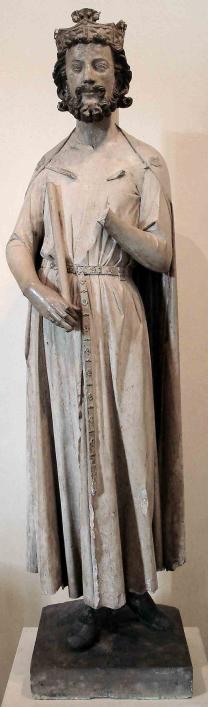
The redoubtable Queen Ultragotha tried to murder our saint, but she paid the price. A highly entertaining story from Pitre-Chevalier, La Bretagne, p. 120 (the Library has Edgar MacCulloch's own copy). This limestone statue of the Frankish King Childebert, founder of the Abbey of St-Germain-des-Prés, is in the Louvre Museum.¹
St Sampson was born into a noble Cornish family around 480 CE. He was Bishop of Dol in Brittany. "A divided Brittany was in chaos. Three brothers pretended to the throne. (Another brother was Tugdual, who became a saint himself, with a chapel on Herm). One, Hoël II, had been murdered. His son, Prince Judual, sought refuge in Paris, at the court of the Merovingian king Childebert. Childebert was in no hurry to help the prince and held him several years, while he decided how best to exploit the situation. Many curious tales are told of Judual in exile. Eventually Sampson resolved to bring him back to Brittany. Unfortunately, Childebert's queen, Ultragotha, found Judual very attractive indeed and decided to put a stop to negotiations by murdering the bishop. First she gave him poisoned wine. Samson made the sign of the cross over it; the glass shattered and the cup-bearer's hand was immediately covered with pustules. Sampson forgave the cup-bearer, who was at death's door, and made the sign of the cross over his arm. He was instantly cured. Next, the queen arranged that Sampson should be given the wildest horse in the royal stables to ride: Sampson made the sign of the cross over the horse, and rode it as if it was the gentlest horse in the world. This made the queen really angry. She was determined Sampson should die, so one day when the bishop was strolling in the courtyard of the castle she unleashed a lion she had been keeping in a dungeon. The lion rushed at Sampson, its jaws wide: but Sampson raised his hand and made the sign of the cross before the animal, and it dropped down dead at his feet. The following day, Sampson was celebrating mass for the king. To please her husband, the queen also attended, but as soon as the saint began the mass, she turned her back to the altar and started to chat and laugh with her ladies-in-waiting. Her punishment was severe, however. She was suddenly violently ill: blood poured out of her nose and ears and other parts of her body, and no-one could stop the flow. She died three days later. Prince Judual eventually returned to Brittany alongside a Merovingian army."
This photograph, by Neuceu, is licensed under the Creative Commons Attribution-Share Alike 2.5 Generic, 2.0 Generic and 1.0 Generic license. Louvre Museum, CC BY-SA 3.0 <http://creativecommons.org/licenses/by-sa/3.0/>, via Wikimedia Commons.