19th century

Jacques Le Batard

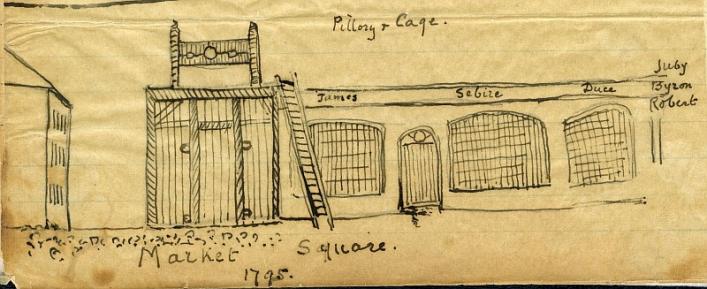
The Gazette de L'Isle de Guernesey, of which the Priaulx Library has copies to view, published an unusual announcement in July of 1795. The newspaper reproduced in its entirety the sentence passed in the Royal Court upon a Frenchman from St Germain in Normandy, called Jacques Le Batard. The results of criminal trials were not normally published in the early Gazettes. Why this one? The sketch of the pillory and cage in 1795 are from the Lukis memoirs in Edith Carey's Scrapbooks in the Library.

The death of Mary Saumarez, October 1812

A letter from the Library's Mann-Dobrée collection, edited by Julia de L. Mann: Anne Dobrée to Henry Routh, October 8, 1812. Nineteen-year-old Mary Dobrée Saumarez was the eldest daughter of Admiral James Saumarez and his wife, Martha Le Marchant; Anne was her cousin. Henry 'Harry' Le Mesurier, son of Havilland, had just lost his arm at the Battle of Salamanca.

Lines, on the lamented death of Captain Dobree, R N

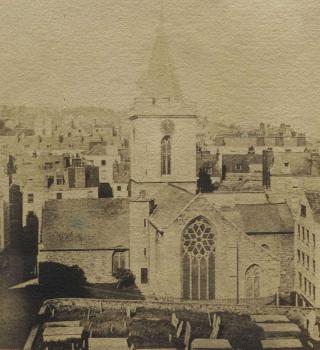
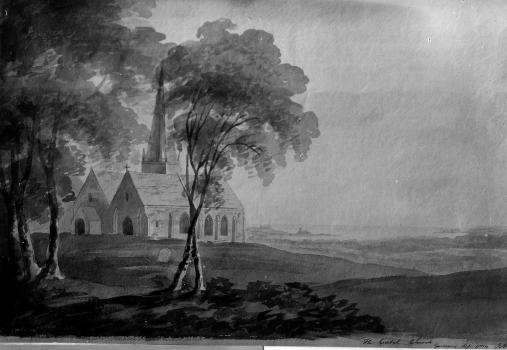
'Who lost his life in a humane attempt to save the lives of shipwrecked seamen on the coast of this island.' From L'Independance, March 14th, 1818; followed by excerpts from the sermon given at the Castel church on 15th March 1818 by Nicolas' young contemporary, the Reverend William Guille. The watercolour of the church is dated 1804 and is signed JM (for Dr John MacCulloch).

J H Ingrouille, 1916

At the meeting of the Loyal Guernsey Lodge of Oddfellows, held at Lower St Julian's last evening, the officers wore mourning regalia as a tribute of respect to the late Mr J H Ingrouille, who was one of the founders of this great Friendly Society. The following may be read with interest by local Oddfellows: Mr John Ingrouille was the survivor of half-a-dozen Guernseymen on whom rested the honour of starting the great Friendly Society movement in this island. In the upper room of the café in the States Arcade, then a hotel kept by Bro. Rougier, was formed by the six, the Loyal Guernsey Lodge…

The notorious Frenchman D'Orlean, 1836

'I have cured persons whom the Doctors had given up; if I am guilty it is of that.' The King versus D'Orléan, the conclusion of a protracted case which opened in the Royal Court, Saturday, December 10th, 1836. Much of the evidence was heard in camera. D'Orléan was practising as a veterinary surgeon. The folk of the country parishes—Judith Lainé, the Bichards, Rihoys, Reniers, Mahys, Galliennes and Ogiers, in this case—are as usual regarded as ill-educated and credulous by Guernsey's sophisticated urbanites. The details of the case are reported in the Comet of February 6, 1837.

Pages