Witchcraft & Folklore

Elie Brevint on witchcraft
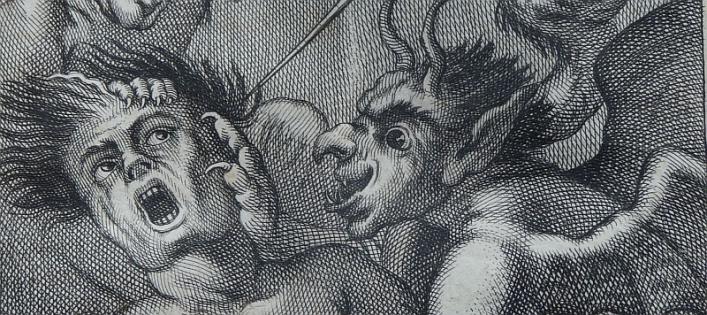
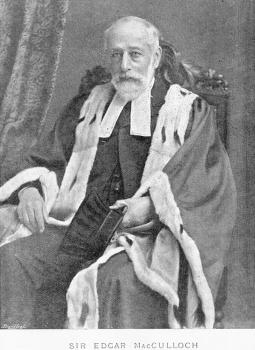
Elie Brevint (1587-1674) was minister of Sark from 1612. His father Cosmé, also a minister, was a Huguenot refugee from Angoulême who had accompanied Helier De Carteret from Jersey in his colonisation of Sark. Transcriptions and microfilm of Elie's 14 Notebooks, which were found in a loft in Sark in the 19th century, are held in the Priaulx Library. Elie appears to be a sensible and rational man with a curious and detached mind, until he turns to these sorts of subject: the Pousseresse, perturbateurs, and salamanders. The illustration is of the Tormento do Tacto, or Torture, from Alexander Périer's O Desengano dos Pecadores of 1724, in the Library.
The witch and the raven: The life of Helier Fautrart, by John Quick, ed. E.P. Le Feuvre

Icones Sacrae Gallicanae et Anglicanae was compiled by John Quick, a Presbyterian clergyman who was born in Plymouth in 1636. Helier Fautrart's life as Rector of St Peter Port Church is one of the biographies of fifty 'French divines' he gathered together in his first work; he followed this with twenty English ministers. He has, however, conflated the life of Helier, who ministered in Jersey, with that of his son, Daniel, who became minister of the Town Church in Guernsey in 1633. This volume includes a fascinating witchy tale.

La Magie naturelle: Grimoires

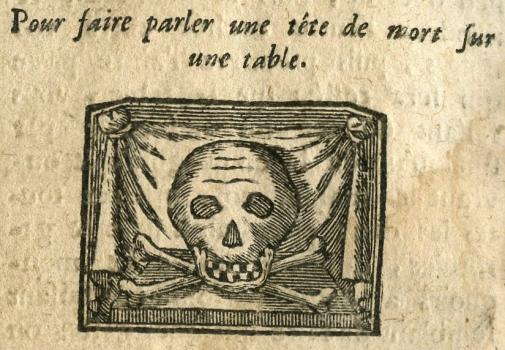
Grimoires are books of household magic. Two in particular, Le Grand Albert and Le Petit Albert, were enormously popular in France throughout the 18th and 19th centuries. A curious mixture of esoteric science and totally impractical superstition, they were for some time tolerated by the Church, with whose teachings they sat uneasily, but were prized by the ordinary people who tried valiantly to reconcile their belief in Christianity with their fear, or hope, that 'natural' magic might just have the power to overcome nature itself.

Pages

Categories