From the Gazette de Guernesey. The illustration shows the prime, from Grisier's 1864 Les Armes et le duel, in the Library. See Monsieur Siordet's fencing school, below.
From the Recueil d'Ordonnances de la Cour Royale, Vol. I, 1852, ed. R. MacCulloch. This seemingly repressive edict in fact represents the desperation felt by the authorities, who were unable to control the excesses of Guernsey youth, no matter how hard they tried.
From the Guernsey Magazine (Monthly Illustrated Journal), February, 1889.
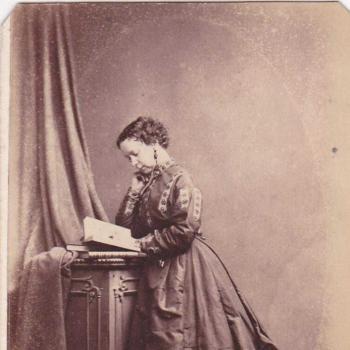
A brief obituary of a pioneering woman, from The Monthly Illustrated Journal (the Guernsey Magazine), February 1889. Mary Esther Sharshaw, born in October 1821, daughter of Henry Cumber and Mary Gallienne, was a pharmacist. The obituary does not mention that she came from two families of prominent Quakers. The two photographs of Mary, which are reproduced courtesy of their owner, both show her with a book. In the lower picture she is sporting a fine calabash, a typical Guernsey ladies' hat; the photograph is by her sister, the Guernsey photographer Sarah Louise Cumber.
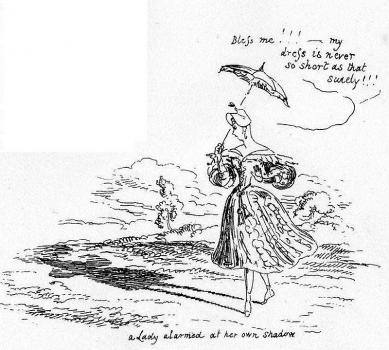
Vive la Flounce! A comic piece in the form of a letter to the Editor of the Star newspaper of July 24, 1834, on the islands' peculiar custom of 'flouncing,' or affiancing, by a visiting wit who called himself 'Time-killer;' and a description of flouncing in Alderney, from Captain Wood's Subaltern Officer, published in 1825. The pictures are from Cruickshank's Sketchbook of 1834-6, part of the Priaulx Library's extensive collection of work by this illustrator.
Frivolous actions for defamation, from the Gazette de Guernesey of June 24, 1826. The newspapers liked to print letters and other examples of Guernsey French, but even the French language newspapers such as the Gazette often seemed to be scoffing at the 'rustics' of the country parishes: these antagonists were from the Forest.
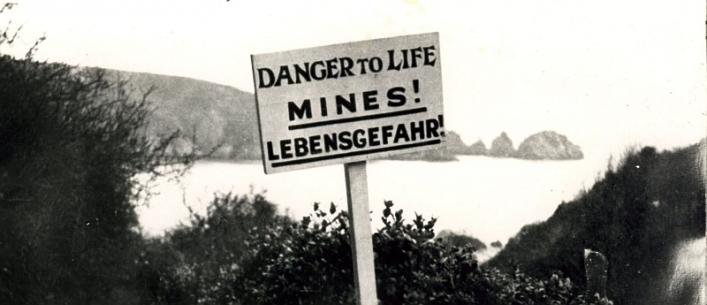
Guernsey, a poem by Oberleutnant Burkert. From Deutsche Guernsey Zeitung, the newspaper of the occupying forces. The photographs above and below from the Library Collection show mine warnings at Fermain Bay and anti-landing defences at Saints Bay.
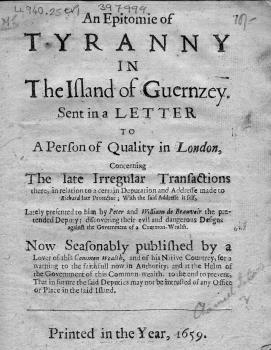
Oliver Cromwell died on September 3, 1658. The States sought to send an address of condolence and loyalty to his son, 'his highness' Richard Cromwell, but were prevented from doing so by the Lieutenant-Governor, Captain Charles Waterhouse, who found their petition 'too submissive.' The leader of the republican party, Pierre De Beauvoir des Granges (1599-1678) and William De Beauvoir du Hoummet, potentially a less committed republican, wrote a defiant letter to Waterhouse, pointing out the Guernsey public's many grievances against him, and proceeded to sneak out of Guernsey and present their petition to Cromwell anyway, taking the opportunity to plead for the unpopular Des Granges to remain as Bailiff. Their actions prompted the publication of a pamphlet, An epitomie of tyranny in the island of Guernsey, which can be found in the Library. It was published anonymously at the beginning of 1659, and accuses the De Beauvoirs of all kinds of misdemeanors.
'Un morchié de terrain qui n'a pas été frumai.' From the Star.
Colonel Edward Popham reports on his search for Prince Charles, who was suspected of attempting to take refuge in Jersey, which he had already visited in 1646. Popham must have missed him, because Charles did find his way to Jersey in that month, and stayed until February of 1650.
Subscribers to the fund giving thanks to the Bailiff for his efforts in stopping restrictive clauses of a proposed Corn Bill, from L'Independance and The Star, and for sorting out problems with the Rum Bill, from the lucrative privileges of which the Bailiwick had been excluded. The Artisans and the Country parishes collected separately for different pieces of plate, presented in 1823.
Extracts from the French language local newspaper L'Indépendance, and the English-language Star.