The story of a picture in our collection, rather than a book; a black-and-white photograph of a watercolour showing Jerbourg Signal Station. Behind the signal-post is Saumarez Tower, the only known representation of this short-lived landmark. A copy of this watercolour is in the possession of the Guernsey Museum. In that picture, the roofs and the small cylindrical tower are shown as red. The photograph, taken at the behest of Captain Philip de Saumarez, was lent a century ago to local historian Edith Carey by Mrs Ozanne, the artist's descendant, and placed in one of Miss Carey's scrapbooks, now at the Library.
Some fascinating letters from a young Caroline Guille Le Marchant to her friends in Bath and London, from Edith Carey's Scrapbook, and some contemporary winter ladies costumes for Christmas, from two bound volumes of fashion-plates, entitled in French Figures. The plates are hand-coloured; some are from The Fashions of London and Paris, a monthly magazine that began publication in 1798, published by Richard Phillips.
Guernsey & Jersey Magazine, June 1836.
We asked the question—who or what were they?
The Priaulx Library holds a small suite of rare books on the subject of Italian Comedy, the most desirable of which is probably Luigi Riccoboni's Histoire du theatre Italien, depuis la decadence de la Comedie Latine; avec un catalogue des tragedies et comedies Italiennes imprimees depuis l'an 1500, jusqu'a l'an 1660, et une dissertation sur la tragedie moderne Paris : Imprimerie de Pierre Delormel, Rue du Foin, Sainte Genevieve, 1728. 60p., [18] leaves of hand coloured plates, one folding. (8vo). Bound with Dell'Arte rappresentativa; Capitoli sei, London, 1728.
The earlier history of the Grange, according to the Library's 19th-century Lukis MSS, transcribed by Edith Carey. Edith Carey's additions are in brackets.
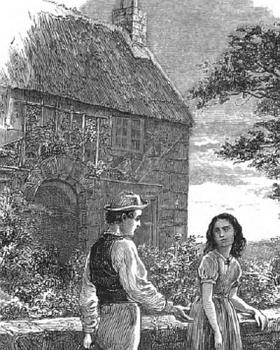
The swarthy locals and their barbarous dialect, an excerpt from the Dublin University Magazine, 1846. This is no doubt based on Inglis' 1834 description of the Guernsey peasant: 'I cannot greatly compliment the personal appearance of the Guernsey country people. There are dark and sparkling eyes among the women .... The men are, with few exceptions, badly limbed; and among the women too, the bust is better than the ankles.'
From the second half of a long but entertaining two-part article from the Dublin University Magazine of 1846. 'Let us now hasten to the proper subject of this paper, the state of society in Guernsey.'
In 1885 was published the original French text of the Ecclesiastical Discipline for Guernsey, edited by the Reverend G.-E. Lee of the Town Church and published by Thomas Bichard of the Bordage. The Police et discipline ecclesiastique was a set of regulations for the management of the Church and its congregation in the island, established by consensus in 1576 and which, despite the severity of its rules, remained in force until the Restoration in 1660, when Charles II imposed a form of Anglicanism on the island.
An excerpt from the Magasin Pittoresque, 17, of 1849: 'Les Iles Anglaises de la Manche.'
From Redstone's Royal Guide to Guernsey, written by Louisa Lane Clarke, who produced a new edition in 1856 following Queen Victoria's visit to Guernsey. A rather rosy description of vraicing—the gathering of wrack seaweed—which was in fact a highly competitive scramble for a valuable and free commodity, much prized by the islanders.
How to get the best from Guernsey's unique church registers. Now available on FindMyPast (free access in the Priaulx Library).