From the London Chronicle , Vol. 9. Guernsey and Jersey are accused of helping the French to put British fur traders in Canada out of business; the claim is denied.
From The London Chronicle.
From The Star 29 and 31 January 1878. With this fascinating document should be compared the Library's manuscript Notebook of Pierre Henry. Henry, whose ancient house in Berthelot Street is now a tourist attraction, was a wealthy merchant shipowner and ancestor of the Tupper family, through whom the notebook came to the Library.
Captain Thomas Saumarez, RN, uncle of Admiral James Saumarez, had a surprisingly easy time when taking possession of the French ship Belliqueux. As a reward he was made commander of the ship and took her on a campaign to the West Indies, but was forced to retire through ill-health. From Sir John Ross' Memoirs and correspondence of Admiral Lord de Saumarez, 1838.
From The Gentlemen's Magazine , XV, p. 694. The Elizabeth , MacKenzie, from Virginia, taken the 15th inst. off Falmouth, by the Lys privateer of St Maloes, and the same night lost on the rocks off Guernsey, but two English and eleven Frenchmen saved.
John Kemp, John Kemp, so bad they hanged him twice! The strange case of John Kemp, and the mystery as to why the rock was named after him is solved.
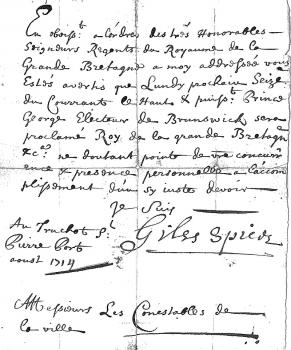
A translation of part of Laurent Carey's manuscript On the Customary Law of Guernsey, from the Guernsey and Jersey Magazine, Vol. V, 1838, edited by F. B. Tupper. Carey's Essai, written around the 1750s, formed the day-to-day reference for the proceedings of the Royal Court, under whose auspices it was eventually published in 1889. Here he was illustrating the fact that the inhabitants of Guernsey can choose to accept the proposed sovereign or not, who, once accepted, becomes 'un prince de leur propre choix'—and display absolute loyalty when they do so. The photograph below shows the proclamation of George V in Guernsey in 1910. The letter above is an invitation from the Governor to the constables to attend the proclamation of 1714. Library collection.
The Romantic author and politician François-René de Chateaubriand, wounded and weakened by dysentery, became extremely ill on a crossing to Jersey, on the way to his native Brittany to join royalist rebels. Chateaubriand managed to make it to Jersey, where he was delivered into the care of his uncle, the Comte de Bédée, but remained very ill for several weeks. He eventually went into exile in London. This is an extract from his memoirs, Les Mémoires d'outre-tombe, Book 10, Chapter III. The 1808 portrait by Girodet-Trioson is in the Museum of Saint-Malo.
Cock-fighting in the churchyard after morning service on Easter Day had once been acceptable, because, according to folk-lore expert J. Linwood Pitts, in 1891, it had a religious origin, 'but became in time to be a scandal, and an Act of Court was passed, forbidding any but gentlemen paying tax on fifty quarters of wheat rent to indulge in the same.'
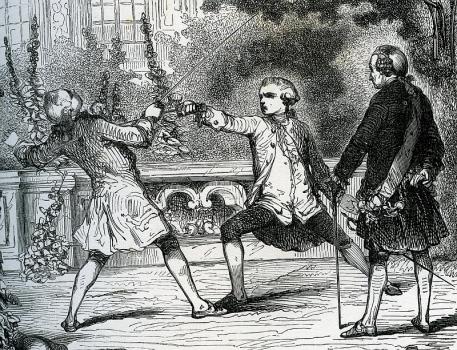
From the Gazette de l'Isle de Jersey, January 8, 1791. The autocratic Le Marchants—the Bailiff and his two sons—and their provocative behaviour. The original is in French. The illustration is from Augustin Grisier's Les Armes et le duel, 1865, from the Library collection.