How to get the best from Guernsey's unique church registers. Now available on FindMyPast (free access in the Priaulx Library).
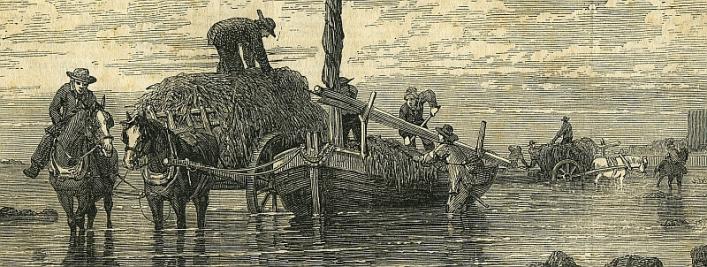
From Redstone's Royal Guide to Guernsey, written by Louisa Lane Clarke, who produced a new edition in 1856 following Queen Victoria's visit to Guernsey. A rather rosy description of vraicing—the gathering of wrack seaweed—which was in fact a highly competitive scramble for a valuable and free commodity, much prized by the islanders.
An excerpt from the Magasin Pittoresque, 17, of 1849: 'Les Iles Anglaises de la Manche.'
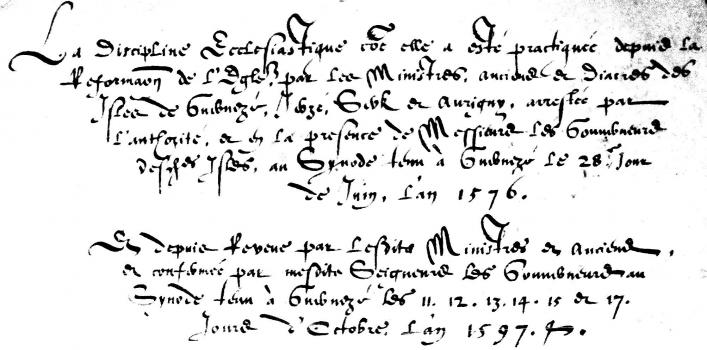
In 1885 was published the original French text of the Ecclesiastical Discipline for Guernsey, edited by the Reverend G.-E. Lee of the Town Church and published by Thomas Bichard of the Bordage. The Police et discipline ecclesiastique was a set of regulations for the management of the Church and its congregation in the island, established by consensus in 1576 and which, despite the severity of its rules, remained in force until the Restoration in 1660, when Charles II imposed a form of Anglicanism on the island.
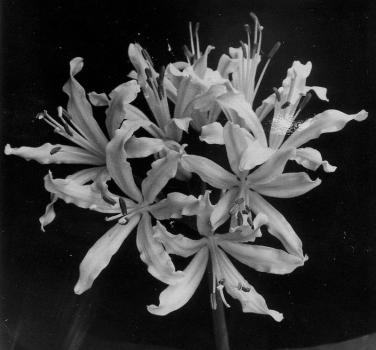
Written in September, 1763, by the Christian visionary, Christopher Smart. The photograph of a Guernsey lily, which flowers in autumn, is from the Carel Toms collection.
A poem in Guernsey French, author unknown, about the demolition of Fountain Street and the building of the Markets, quoted by Louisa Lane Clarke in The Folk Lore of Guernsey and Sark, 1880. The linguistic notes are hers.
The Regular Army and British Navy For up-to-date general information consult Family history in the wars: how your ancestors served their country, by William Spencer.¹ Army Lists A catalogue of Army and Navy Lists held at the Library can be downloaded at Historical Lists of Armed Forces Personnel at the Priaulx Library: Resource List 2 . These are useful to trace officers of the British Army and Navy and the East India Company, but not all years are available in the collection. The Official Army Lists in the Priaulx Library run from 1756 to 1844. We also have other lists from various years in…
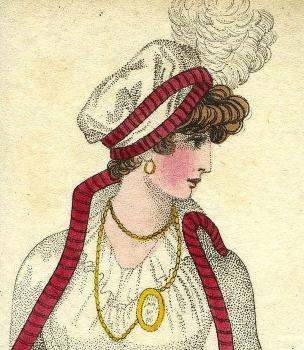
Some fascinating letters from a young Caroline Guille Le Marchant to her friends in Bath and London, from Edith Carey's Scrapbook, and some contemporary winter ladies costumes for Christmas, from two bound volumes of fashion-plates, entitled in French Figures. The plates are hand-coloured; some are from The Fashions of London and Paris, a monthly magazine that began publication in 1798, published by Richard Phillips.
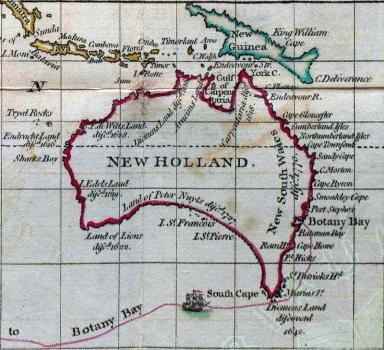
Eden, William, 1st Baron Auckland (1744-1814), The History of New Holland, from its first Discovery in 1616, to the present time. With a particular account of its Produce and Inhabitants; and a Description of Botany Bay: also, a List of the Naval, Marine, Military and Civil Establishments, to which is prefixed, An Introductory Discourse on Banishment, London, 1787, Printed for John Stockdale, opposite Burlington-House, Piccadilly, 1787. The map, a plate from the book, shows the route to Botany Bay. This volume came to the Priaulx Library as part of Elizabeth College's Le Marchant Library Collection.
Icones Sacrae Gallicanae et Anglicanae was compiled by John Quick, a Presbyterian clergyman who was born in Plymouth in 1636. Helier Fautrart's life as Rector of St Peter Port Church is one of the biographies of fifty 'French divines' he gathered together in his first work; he followed this with twenty English ministers. He has, however, conflated the life of Helier, who ministered in Jersey, with that of his son, Daniel, who became minister of the Town Church in Guernsey in 1633. This volume includes a fascinating witchy tale.
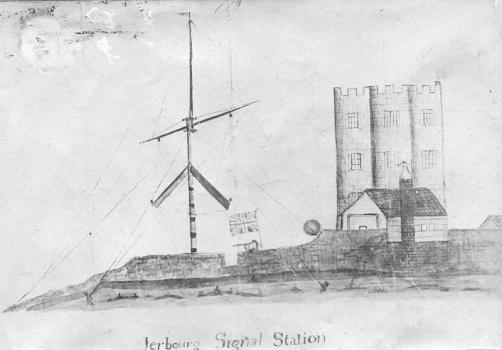
The story of a picture in our collection, rather than a book; a black-and-white photograph of a watercolour showing Jerbourg Signal Station. Behind the signal-post is Saumarez Tower, the only known representation of this short-lived landmark. A copy of this watercolour is in the possession of the Guernsey Museum. In that picture, the roofs and the small cylindrical tower are shown as red. The photograph, taken at the behest of Captain Philip de Saumarez, was lent a century ago to local historian Edith Carey by Mrs Ozanne, the artist's descendant, and placed in one of Miss Carey's scrapbooks, now at the Library.
Excerpts from the log-book of Captain William White of the Jerbourg Signal Station, as printed in the Guernsey newspaper The Star c. 1904.