The earlier history of the Grange, according to the Library's 19th-century Lukis MSS, transcribed by Edith Carey. Edith Carey's additions are in brackets.
The swarthy locals and their barbarous dialect, an excerpt from the Dublin University Magazine, 1846. This is no doubt based on Inglis' 1834 description of the Guernsey peasant: 'I cannot greatly compliment the personal appearance of the Guernsey country people. There are dark and sparkling eyes among the women .... The men are, with few exceptions, badly limbed; and among the women too, the bust is better than the ankles.'
From the second half of a long but entertaining two-part article from the Dublin University Magazine of 1846. 'Let us now hasten to the proper subject of this paper, the state of society in Guernsey.'
Shame and humiliation, the penalty for not conforming: the Amende Honorable, or Porter le linceuil.
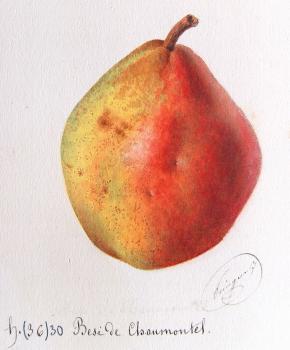
'There is a pear which is peculiar to these islands, the Chaumontel, which grows to an extraordinary size, and sells very frequently for a shilling each for exportation.' From Cochrane's Guide to the Island of Guernsey, 1826. 'Guernsey supplies to London, besides granite pavement and chaumontelle pears, megalithic theories and watercolour paintings.' The Channel Islands Magazine, May, 1853. The watercolour is from Alphonse Mas' Le verger (The kitchen garden), 1865.
From the Supplement to the Memorial of the Jersey Reform Committee to the Commissioners apppointed by Her Most Gracious Majesty to enquire into the civil, municipal, and ecclesiastical laws of Jersey and for other purposes, 1859, p. 39. The Jersey upper classes appropriate a Guernsey Order in Council, to ensure they are correctly addressed by the lower orders.
The sprightly Muse her wing displays. And the French islands first surveys—Drayton's poetic description of Britain, written in 1612, opens with the Channel Islands. This is the 1813 rendition into modern English by Robert Southey. The Library has a facsimile of the 1622 edition, published for the Spenser Society in 1889.
The poet George Métivier's family home, St George in the Câtel (the painting of the house is by Young, 1821), was planted with cherry trees, about which he fondly reminisced, along with the birds that feasted on them. Here are some excerpts from the Guernsey Magazine of November 1884 about cherries, taken from a series called 'Guernsey Popular Names of Plants, as compared with those in other places,' No. 8, 'Based on Mr Métivier's Glossaire.'
'It has been truly said that the history of Guernsey, for the last fifty years of his life, was in fact the history of Daniel de Lisle Brock (A New General Biographical Dictionary, 1857).' The article reproduced below is from the Eclectic Review of 1845.
Almanac Journalier: Guernsey, Chevalier & Mauger, 1820
In the mid-19th century Frederick Clarke produced in his establishment in the States Arcade this little booklet, attempting to distil in four pages the labyrinthine system of weights and measures at that time employed in the island. Its difficulty was compounded by the sheer number of currencies that island merchants and traders had to deal with. The information is taken literally from schoolmaster Thomas du Frocq's Nouveau Precepteur of 1818, which is a (mainly) applied mathematics primer of tortuous complexity and much greater length.
Extracted from a review of Guernsey by the then Governor, Lord Hatton, known under the pseudonym of 'Warburton.'