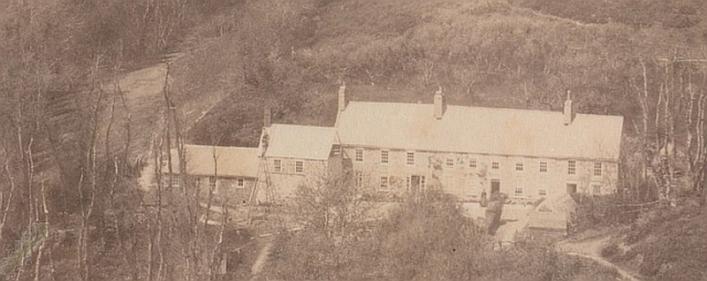
From George Wearing's A Farmer's Vacation, 1873, pp. 231 ff. The photographs are from the Library collection; that of the Seigneurie in Sark is by Thomas Singleton and dates from c. 1875; above is Baker's Valley in around 1880. 'The population of the island is less than six hundred souls, and of these over ten per cent are confirmed drunkards.'
From Sarnia's record in the Great War, published by The Star in 1919.
From Scribner's Monthly Magazine, X (5) September 1873, later collated and published as A Farmer's Vacation.
Guernsey, from an article in the influential American publication, Scribner's Monthly Magazine, September 1873; the article is one of a series eventually brought together as a book, A Farmer's Vacation, by George Wearing, published in the same year. Interest in the exportation of Guernsey cattle to North America and their management was bringing significant numbers of US farmers or their agents to Guernsey in this period. Wearing had first visited Jersey, to compare their agricultural procedures. Below is the Couture Water Lane in St Peter Port, admired by the author.
The Moie de Mouton cave, by a credulous R. Ellis, from the book Rambles among the Channel Islands, by a naturalist, 1854.
The largest cave in Guernsey, once a major tourist attraction. From the Monthly Illustrated Journal, (Guernsey Magazine), October 1888, p. 85; and the cave in 1951, when a party of three including a press photographer go in search of bats there. The illustration is a detail looking out of the Creux Mahie from a small 19th century visitor's guide to the cave.
From Samuel Lewis' A Topographical Dictionary of England, 1831.
From the Guernsey Press of May 11th, 1939; 'Heard in the Bordage' by Stargazer.
Extracts from the bound collection of transcribed MSS known as the Nicolas Dobrėe MSS. All in beautiful copperplate, they include versions of charters and other Royal Orders and Acts, and various letters patent and so on that were obviously regarded as highly significant by the volume's owner. Followed by a transcription made in 1730 of the Constitutions of King John, from 'an old translation into French from the original in Latin ... copied from the Book of Mr H Mauger, Comptrolleur,' part of a collection of legal documents probably belonging to former Bailiff Peter de Havilland.
From The Ladies' Companion and Monthly Magazine, 1868. Old-fashioned and full of Latin tags but more fun that you might think. 'For be it remarked here, that the Alderney girls age remarkably fast, and very probably the charmer who is carrying on a conversation with you, and parrying all your flirting and causerie, with all the nerve and steadiness of five-and-twenty, is, after all, only adorned by the petitionary grace of sweet seventeen.'
Elie Brevint (1587-1674) was minister of Sark from 1612. His father Cosmé, also a minister, was a Huguenot refugee from Angoulême who had accompanied Helier De Carteret from Jersey in his colonisation of Sark. Transcriptions and microfilm of Elie's 14 Notebooks, which were found in a loft in Sark in the 19th century, are held in the Priaulx Library. Elie appears to be a sensible and rational man with a curious and detached mind, until he turns to these sorts of subject: the Pousseresse, perturbateurs, and salamanders. The illustration is of the Tormento do Tacto, or Torture, from Alexander Périer's O Desengano dos Pecadores of 1724, in the Library.
Another extract from the Monthly Illustrated Journal, July, 1888.