Is it indeed true am I here? divided by the Atlantic from a mother so justly adored, a father so truly beloved, my parents—Oh! let me still think I am dreaming—that I have not left you—bid you such a long, such a sad adieu.
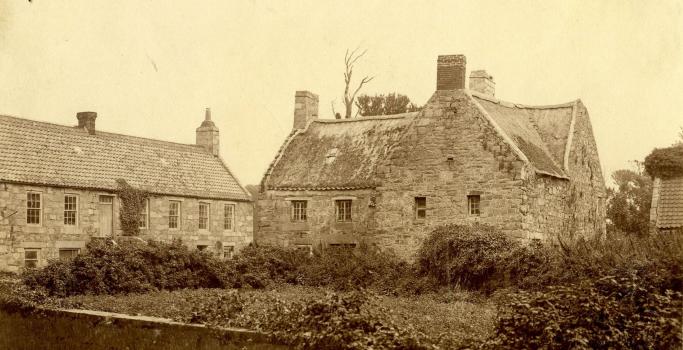
'One of the quaintest possible specimens of an old Guernsey dwelling'; so says the author of a report in The Star, October 20, 1915, under the byline: 'Another ancient landmark disappearing.' The photograph is by Edith Carey. She says tradition had it that the house was built in the 12th century and was connected with the Fief au Comte; the house on the left was demolished in 1921.
An amusing anecdote from a Methodist pioneer in the island.
The Bordiers.
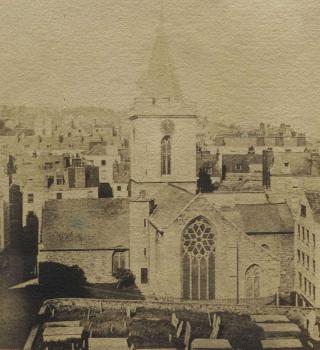
'Like mournful echo from the silent tomb, That pines away upon the midnight air, Whilst the pale moon breaks out with fitful gloom, Fond memory turns, with sad but welcome care, To scenes of desolation and despair, Once bright with all that beauty could bestow, That peace could shed, or youthful fancy know.' From The Deserted Isle, by Margaret Blennerhassett. Harman Blennerhassett was a clever but eccentric Irish republican who 'married' his niece, became involved in an abortive but notorious plot to make Texas independent, and ended up buried in Guernsey. The photograph above is from the Library Collection and shows the Cimitière des Soeurs, or Sisters' Cemetery, in 1870. The modern photographs in the article are of the Strangers' Cemetery as it is today.
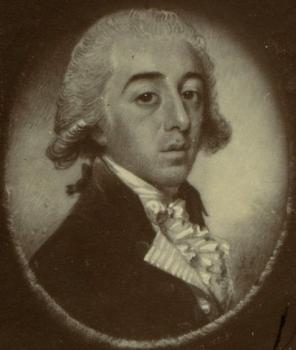
Notes by Miss Mary Elizabeth Guille on some Brock portraits. Written November 29 1902, when she was aged 81. William Brock, Henry Brock, and Harriet Brock were children of William Brock (1725-1768) and Judith de Beauvoir. The leading portrait is of William Brock; it is signed P J, for Philip Jean, and dated 1786.
An inquest into the death of the eldest son of Sir John St John, of Lydiard Tregoze, in Wiltshire, and his young tutor, who died trying to rescue his charge. They were swept away by the current, probably off Belvoir Bay, 18 August, 1597. Walter St John was under the protection of the Governor, Sir Thomas Leighton, and living at Castle Cornet. It is extremely unusual for evidence in a case like this to survive; this was retained because Walter's family connections meant an account of the inquest had to be sent to Chancery. The French text is given in the Second Report of the Commissioners into Criminal Law in the Channel Islands of 1848.
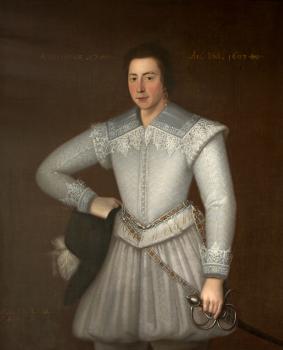
A short introduction to the main characters in the 16th-century tragedy of Walter St John and Isaac Daubeney, pupil and teacher. The portrait is of Walter's younger brother, John, aged 17; he was very close in age to Walter. The portrait was kindly provided by Lydiard Tregoze house.
Four accounts of Tom Sticks, from Edith Carey's Scrapbook, Vol. I., and letters from the Library's Dobree-Mann transcriptions. 1. Thomas Le Marchant, a retired Lieutenant of Mariners (familiarly called Tom Sticks by the Patricians and Le Ramouneux , or Chimney Sweep , by the Plebeians); by his miserly habits he hoarded so much money that he 'cut up' splendidly [ his brother Charles inherited it ]. Tom Sticks obtained his name of Le Ramouneux as follows. Believing that he had made a conquest of Miss Laperre of Les Blancs Bois, he thought to take her by surprise, as Jove did Danaë, by…
From Edith Carey's Scrapbooks, Vol. I.; the Lukis MSS.
Amongst several of the De Sausmarez family to bear this name, the Matthew De Sausmarez who lived in the island in the late 18th century is one of the best known. Amongst his titles was Châtelain of the Castle at Jerbourg, and it was he who built the Sausmarez Tower there, the only defensive tower of that era not following a military plan. It is unlikely that he did it out of altruism. J. Chepmell, in the MS Memoirs held at the Library, has some very unflattering things to say about him.
A genealogist's nightmare, from The Comet of February 9, 1854.