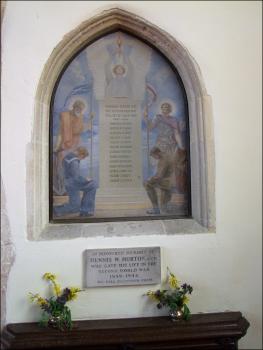
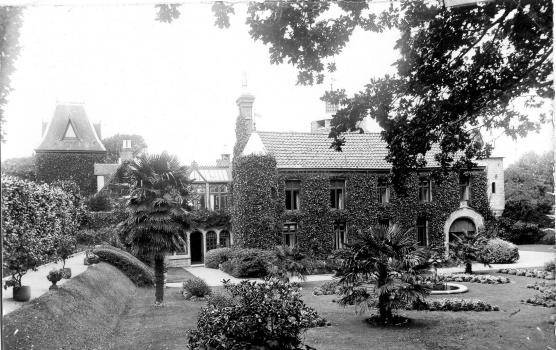
From Rosemary de Saumarez's reminiscences of James St Vincent Saumarez, 4th Baronet (1843-1937). The photograph of the memorial in Tostock Church is courtesy of Simon Knott. Rosemary Ashley (née de Saumarez) donated a photograph album to the Library in 1984 which contains photographs of Frederick, the sisters, his boat and his cottage at Cobo.
The will of Etienne Falla, son of Etienne. Transcription by Edith Carey in the annotated Pedigree of the Falla Family. With references to the Lainé family.
Transcribed by Edith Carey in the Pedigree of the Falla Family, in the Library.
Who put the rat poison in the wine? Françoise Archenaux, who on Saturday sennight was convicted by the Royal Court of having attempted to poison the family of Mr Daniel Grut LE MASURIER, underwent a part of her sentence by being placed in the cage in the public Market from half-past eleven to half-past twelve. On the four squares of the cage was fastened a printed label signifying the crime for which she was punished, it read thus, namely, Empoisonneuse. There was a multitude of both sexes present to witness the exhibition, whom she addressed at some length, but of the purport of her harangue we know nothing.
There is now an interesting website for this museum, with audio and video tours of the building and collections and a great deal of background information to this branch of the Dobrée family. The Priaulx Library has the standard guide to the museum in its collection, Aptel, Claire, et al., Thomas Dobrée 1810-1895: un homme un musée, France, Fonds Dobrée, 1997 .
More informal gossip from the memoirs of Mr Lukis and Mr Chepmell; the Le Marchant, Le Mesurier, Baynes, and Hutchesson families. How Dr Hutchesson 'fell between two fires.'
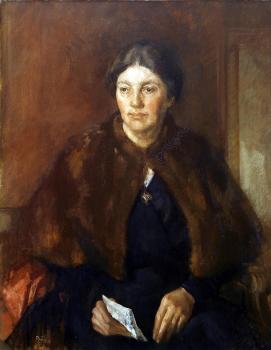
A brief introduction to the life of the scholar Julia de Lacy Mann, an Oxford economist and promoter of women's education, who was one of the last descendants of Margaret and Gother Mann. Without her work on her family letters Guernsey social historians would be very much the poorer. The arresting portrait of her shown here, attributed to Peter Greenham, is in St Hilda's College, Oxford, and is displayed here by kind permission of the College.
An entertaining letter from a collection in the Bodleian transcribed by Julia de Lacy Mann, the working copies of which are held in the Library. It describes in great detail the Guernsey wedding of Margaret Baynes, whose letters from Trinidad have recently been published.
A link to some delighful 18th-century portrait miniatures that have found their way to Australia, and some photographs from the same collection.
The Star, July 7th, 1916: We deeply regret to announce the death in action of Major F G Mockler, DSO, Royal Irish Regiment, which occurred on Sunday, July 2nd.
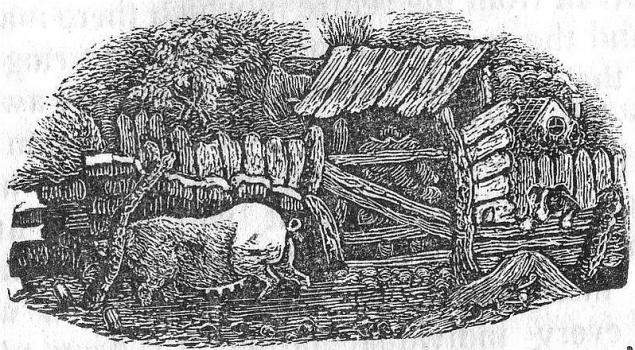
From an editorial in the Star of December 12, 1836. The woodcut of a 'frisky' Guernsey pig is from Dr Thomas Bellamy's Pictorial Directory of 1843, in the Library collection. The writer comments on the credulity of those in the country parishes, who continue to venerate such impostors and quacks as Louis D'Orléan, about to face trial for imposition, and in doing so gives us details of the case of Nicolas Roussel which, although having occurred in 1807, 'is not yet forgotten, and just a few particulars respecting it will not, just now, be unacceptable'.
An appeal to the Royal Court. From the Comet, February 16, 1837.